How to help a cat with separation anxiety 🐈
Here's what to look out for, what causes separation anxiety in cats, and how to help.

Owe Carter
13 August 2026
| 7 minutes read
Reviewed by Dr Nicole Olewinski – BVSc MRCVS
Dog separation anxiety gets talked about constantly – but cats can struggle with it too, even if they’re better at hiding it.
Cats might come across as fiercely independent, choosing exactly when they want fuss and when they’d rather be left alone. But plenty of cats form an attachment to their favourite person, and can find a disrupted routine or an empty house stressful. Here we look at what causes cat separation anxiety, how to spot it and how to help.
What is cat separation anxiety? ❓
Cat separation anxiety is when your cat feels stressed and unsettled when away from you. Cats have a reputation for independence, but plenty form a strong bond with their favourite person and struggle when that person isn’t around.
Anxious behaviour can show up within minutes of you leaving, or even when a closed door means your cat can’t physically get to you. While it typically develops in younger cats, it isn’t limited to any particular age group – kittens and older cats can both be affected.
It’s more common than you might expect too. One study found signs consistent with separation-related problems in around 1 in 7 cats. So if your cat seems to struggle when you’re out, you’re far from alone in dealing with it.
What causes cat separation anxiety? 🧠
Separation anxiety is rarely caused by one thing. It develops from a unique combination of your cat’s genetics, personality, physiology, life experiences and environment. Occasionally there is a specific trigger, but if it happened while you were out of the house, or was something so subtle that only your cat experienced it as stressful, you may never figure out what it was.
More obvious contributing factors can include:
- Being weaned or taken from their mother too early, which can affect key skill development
- Constant attention and affection from owners, without much time spent apart
- A lack of toys or enrichment, leading to boredom and frustration
- Being an only cat who stays indoors, which can increase reliance on their owner for stimulation
- A change to routine or environment, such as losing another pet or family member, or moving house
- A history of trauma from living in multiple homes before joining your family
Cat breeds prone to separation anxiety
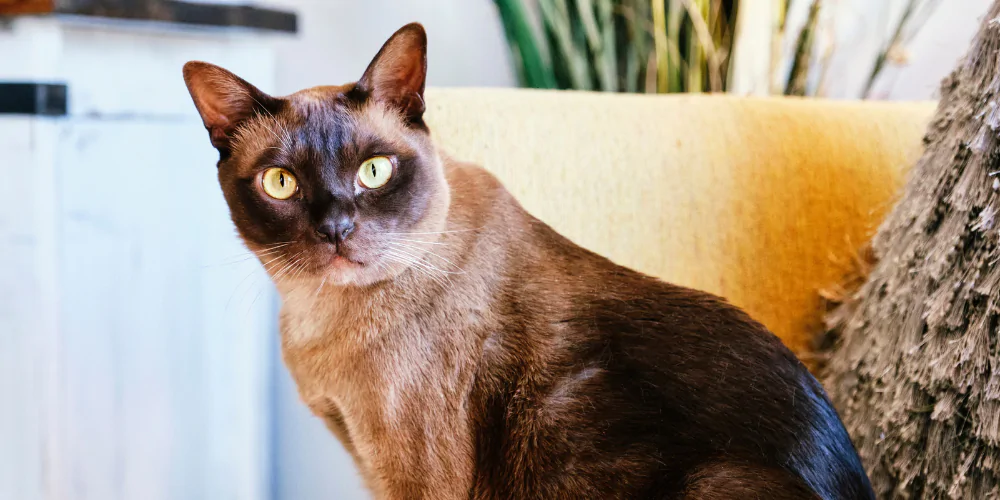
Some breeds are thought to be more prone to separation anxiety than others – particularly sociable, people-focused breeds like the Burmese and Siamese. Both of these were bred as indoor companions and tend to form close attachments to their owners.
Signs of stress and anxiety in cats 👀
Signs of separation anxiety can appear day or night, and might include:
- Destructive behaviour, like scratching furniture or fabrics
- Constantly wanting to be near or in physical contact with you
- Excessive meowing, yowling or crying
- Sleeping more than usual, or seeming unusually lethargic
- Aggression towards other members of the household
- A change in eating habits, such as refusing food while alone
- Spraying, or toileting outside the litter tray
- Excessive grooming, or a sudden drop-off in grooming altogether
These signs can be more noticeable at night, when the house is quiet. It’s also worth knowing that cats can show separation anxiety around other cats in the household, not just their humans.
If your cat seems fine on the surface but you suspect something’s not quite right, a pet camera can be a useful way to check for signs of distress while you’re out of the house.
Our expert vet says…
“You can be the best medicine for your cat. Catching separation anxiety early gives you more time to figure out which strategies work for your cat before anxious behaviours become deeply ingrained.
“While you work on the outside, your vet can advise you on supplements or medications that help on the inside. I’ve found pheromone products and calming supplements surprisingly helpful in some cats. They can help create the right internal conditions for change because stressed, anxious or ageing brains tend to be less adaptable.
“I know it’s almost impossible to ignore a cat determined to get your attention by weaving between your legs… or climbing up them! With my own geriatric cat, I’ve learnt it’s much safer – for both of us – to sit down with a coffee and let him come to me. I allow him to settle himself before I touch him. I share my calm rather than joining in with his anxiety. And, as he’s not very good at grooming himself these days, I substitute some ‘cuddles’ with gentle brushing, so he benefits from a range of positive interactions, not just stroking.”
Dr Nicole Olewinski – BVSc MRCVS

How to prevent cat separation anxiety 🌱
A few habits can help reduce the chances of separation anxiety developing in the first place.
Build a predictable routine
- Keep feeding times, work schedules and playtime as consistent as possible, so your cat knows roughly what to expect.
- Build up alone time gradually, starting with just a few minutes and working up to longer stretches, so they don’t become dependent on constant company.
- Once they’re used to it, keep giving them regular time alone – little and often, rather than only when it can’t be avoided.
Keep them mentally stimulated
- Offer toys and scratching posts that tap into natural predatory behaviour – fast-moving toys, ones with fur or feathers, puzzles, tunnels, and anything that crinkles or squeaks.
- Hide treats around the room, or use a food puzzle, to encourage their hunting instincts. A cheap DIY option is a folded-up toilet roll tube stuffed with treats.
- Set up elevated spots like window perches and cat trees, so they can watch the world go by.
Balance attention with independence
- Giving constant fuss or cuddles sets an expectation you won’t always be able to live up to, so encourage your cat to enjoy a range of activities.
- Set aside dedicated, predictable play and grooming time, so they get consistent, positive interaction on a schedule rather than on demand.
- Encourage your cat to spend time with everyone in the household, not just one person, to avoid over-attachment.
- Keep one room consistently off-limits, so your cat can get used to a little physical separation without the confusion of changing boundaries.
Make the environment work in their favour
- Create safe spaces like cat trees, walkways or secluded beds in quiet spots where your cat can retreat if things feel overwhelming.
- Leave the radio on, or put together a cat-friendly playlist, if your cat’s used to background noise.
- If they’re an indoor cat, a secure outdoor space like a catio or cat-proof garden can give them fresh air and a change of scenery.
- Keep the litter tray clean and easily accessible, positioned away from food and toys. A second, partly covered tray is worth considering too.
- Go easy on strong smells around the home, like air fresheners and perfume, and try to keep bags and shoes away from the door.
- Trial an exercise wheel or treadmill. Lower energy levels can help your cat relax.
Keep comings and goings low-key
Try to stay calm, and avoid making a big fuss when you leave or come home. The goal is to stop your cat associating your comings and goings with something to get worked up over.
How to calm an already anxious cat 😿
If your cat’s already showing signs of separation anxiety, a few things can help take the edge off while you arrange to see a vet:
- Use a synthetic calming pheromone spray, diffuser or plug-in (like Feliway) to help settle the room
- Move them somewhere dark and quiet where they can wind down
- Offer a distraction, like a toy or puzzle feeder
- If your vet’s prescribed medication, follow the course exactly as directed
- Speak to your vet about calming supplements if you think your cat could benefit from some extra support.
When to consult your vet 👩
If your cat’s behaviour changes, or something seems off compared to their usual self, it’s worth booking a vet check. FirstVet offers 24/7 video appointments with UK vets, and can help advise on next steps for your cat’s wellbeing.
It’s worth ruling out medical causes too, since some symptoms overlap with other conditions. Toileting outside the litter tray, for instance, can be a sign of anxiety – but could equally point to a urinary infection.
If you’re insured with Petgevity, your cat cover also includes behavioural treatment sessions (up to a stated limit), which could help support your cat through separation anxiety.
Other questions about cat separation anxiety ❓
Do cats miss their owners when they go on holiday?
Some do. Cats that are closely bonded to their owner can certainly struggle with extended time apart. Others are perfectly content staying with another household member, a friend, or at a cattery. Getting your cat used to spending time with other people or in boarding environments from a young age can help reduce anxiety if you’re planning to go away.
A cat sitter is another option, though it’s worth thinking through how much time they’ll spend with your cat during visits, and how secure your home is if your cat has access to the outdoors.
Do cats grow out of separation anxiety?
With time, patience and the right approach, separation anxiety can often be eased, even if it doesn’t disappear completely. Follow guidance from your vet or a qualified behaviourist, and take things at your cat’s own pace rather than rushing the process.
Cats deserve support through the tricky moments too – which is why we offer comprehensive lifetime cat insurance that includes behavioural treatment.

